
Blog
Borewell Yield Estimation Methods
Complete Guide for Accurate Groundwater Assessment
Introduction
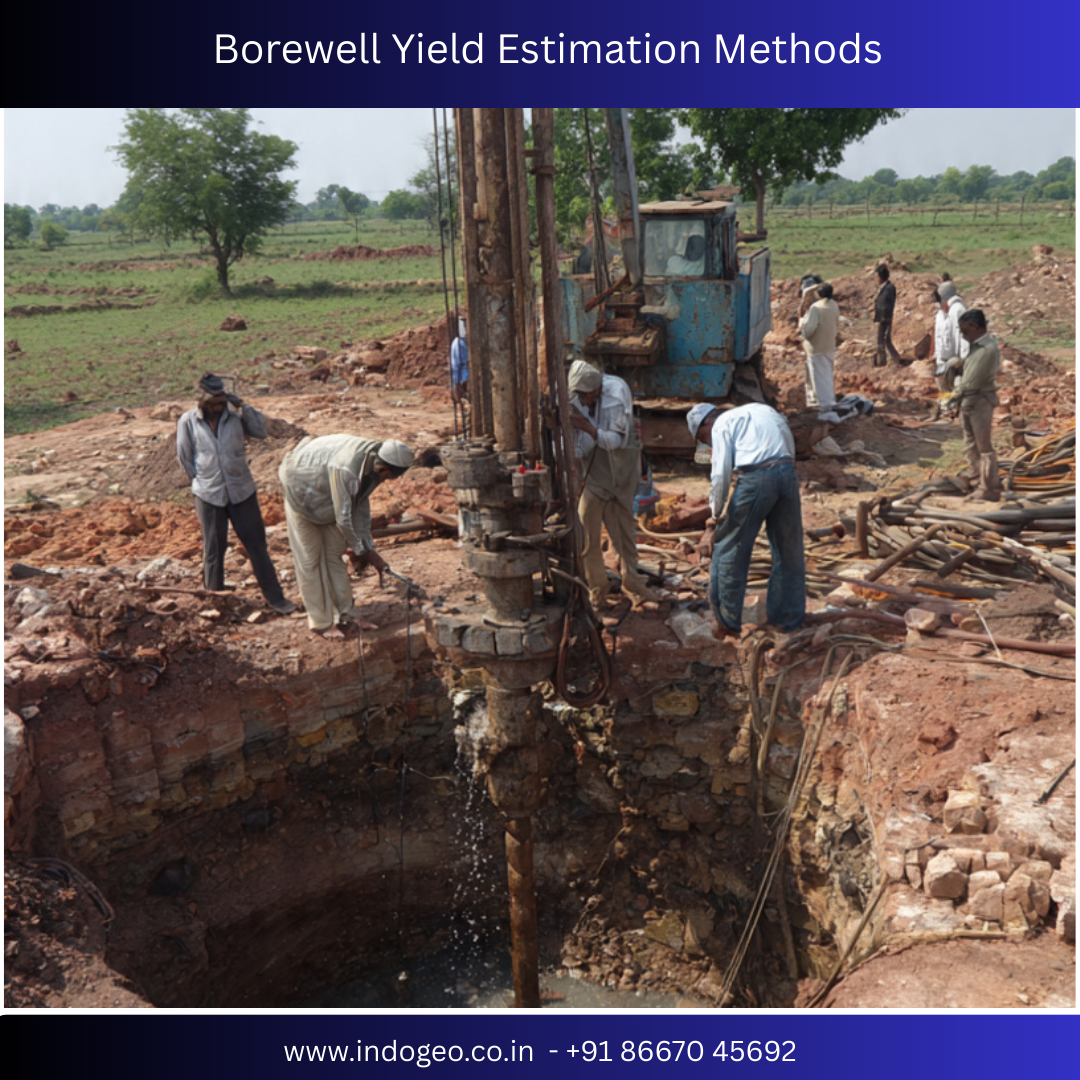
Borewell yield estimation is a crucial process in groundwater development, agriculture, construction, and industrial water supply planning. Accurate borewell yield assessment helps determine the sustainable discharge capacity of a borewell without causing aquifer depletion or pump failure.
Whether you are a farmer, real estate developer, borewell contractor, or hydrogeologist, understanding borewell yield estimation methods ensures long-term water availability and cost-effective investment.
In this comprehensive guide, we explain the most effective borewell yield estimation methods, testing procedures, calculations, and best practices for sustainable groundwater management.
What is Borewell Yield?
Borewell yield refers to the quantity of water that can be safely extracted from a borewell per unit time, typically measured in:
Liters per minute (LPM)
Cubic meters per hour (m³/hr)
Gallons per minute (GPM)
The yield depends on several factors:
Aquifer type (confined or unconfined)
Rock formation and fracture zones
Recharge rate
Borewell depth and diameter
Pump capacity
Seasonal groundwater fluctuation
Why Borewell Yield Estimation is Important?
Accurate yield estimation helps in:
Selecting the right pump capacity
Preventing borewell failure
Avoiding over-extraction
Designing irrigation systems
Planning industrial water requirements
Ensuring sustainable groundwater management
Improper estimation can result in dry borewells, excessive power consumption, and aquifer damage.
Major Borewell Yield Estimation Methods
1. Pumping Test Method (Constant Discharge Test)
Overview
The pumping test method is the most reliable and scientifically accepted method for borewell yield estimation.
Procedure
Install a submersible pump.
Pump water at a constant discharge rate.
Measure water level drawdown at regular intervals.
Continue pumping for 4–24 hours.
Record recovery after stopping pumping.
Key Parameters
Static Water Level (SWL)
Pumping Water Level (PWL)
Drawdown (s)
Discharge (Q)
Formula
Specific Capacity = Q / s
Where:
Q = Discharge rate
s = Drawdown
This method provides accurate sustainable yield estimation and aquifer characteristics.
2. Step Drawdown Test
Overview
The step drawdown test involves pumping at increasing discharge rates in steps.
Procedure
Pump at low discharge for 1 hour.
Increase discharge gradually in 3–5 steps.
Measure drawdown for each step.
Plot discharge vs drawdown graph.
Benefits
Identifies optimal pumping rate
Determines well efficiency
Prevents over-pumping
This method is widely used for agricultural and industrial borewell design.
3. Air Compressor Yield Estimation
Overview
In this method, compressed air is used to lift water from the borewell to estimate yield.
Advantages
Quick field estimation
Low cost
Suitable for rural areas
Limitations
Less accurate
Short-duration testing
Not suitable for final pump design
This method is mainly used during borewell drilling stage.
4. Recovery Test Method
Overview
The recovery test measures how quickly the water level recovers after pumping stops.
Procedure
Pump the borewell for a fixed duration.
Stop pumping.
Record water level recovery at regular intervals.
Analyze recovery rate.
Importance
Indicates aquifer recharge capacity
Helps determine sustainable yield
Useful in low-yield borewells
5. Specific Capacity Method
Specific Capacity = Discharge / Drawdown
This quick estimation method helps:
Compare borewell performance
Identify well clogging
Assess long-term efficiency
Though simple, it should be combined with pumping tests for accuracy.
Factors Affecting Borewell Yield
Geological formation (Hard rock, sedimentary rock)
Fracture density
Borewell depth
Recharge area
Rainfall pattern
Nearby borewell interference
Pump selection
In hard rock regions like many parts of South India, fracture zones play a critical role in yield estimation.
Sustainable Borewell Yield vs Maximum Yield
Maximum Yield: Highest discharge possible during pumping
Sustainable Yield: Safe discharge without aquifer depletion
Always design pump systems based on sustainable yield, not maximum yield.
Recommended Borewell Yield Testing Duration
| Borewell Type | Recommended Pumping Test Duration |
|---|---|
| Domestic | 4–6 Hours |
| Agricultural | 6–12 Hours |
| Industrial | 12–24 Hours |
Longer tests provide more reliable results.
Best Practices for Accurate Borewell Yield Estimation
Conduct geophysical survey before drilling
Maintain proper borewell casing
Use calibrated flow measurement devices
Record detailed test data
Consult certified hydrogeologists
Avoid over-extraction
Conclusion
Borewell yield estimation is essential for sustainable groundwater management and long-term water security. Among all methods, pumping tests and step drawdown tests provide the most accurate results, while compressor tests offer quick preliminary estimation.
For farmers, builders, industries, and infrastructure developers, professional borewell yield testing ensures optimal pump selection, reduced energy costs, and extended borewell lifespan.
Investing in scientific groundwater assessment today prevents water scarcity tomorrow.
Comments
Scroll to Top